




Sterility assurance monitoring is the process hospitals and surgery centers use to confirm that every sterilizer cycle actually produces a sterile instrument, not just a clean one. It combines biological indicators, chemical indicators, and physical monitoring data to verify that reprocessed devices meet a defined sterility assurance level before they reach the operating room. For biomedical equipment technicians and sterile processing teams, this monitoring is one of the few checks standing between a routine sterilizer cycle and a preventable healthcare-associated infection.
This guide covers what sterility assurance monitoring involves, how biological and chemical indicators differ, how to monitor autoclave and steam sterilizer performance, and the validation and recordkeeping requirements survey teams look for during an inspection.
What Is Sterility Assurance Monitoring?
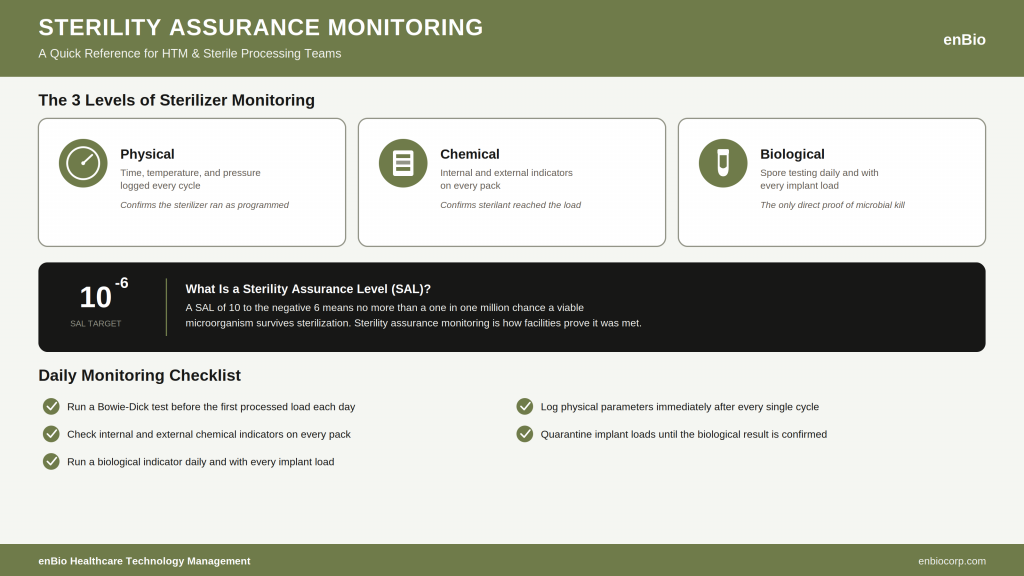
Sterility assurance monitoring is the combination of biological, chemical, and physical checks used to confirm that a sterilizer has achieved a sterility assurance level, or SAL, of 10 to the negative 6. In practical terms, that means the probability of a single viable microorganism surviving the cycle is one in a million. Hospitals rely on this process to catch equipment malfunctions, loading errors, or packaging failures before contaminated instruments ever reach a patient.
No single indicator can confirm sterility on its own. Biological indicators verify that the cycle actually killed resistant spores, chemical indicators confirm that sterilant reached the load, and physical monitoring, meaning time, temperature, and pressure readouts, confirms the sterilizer performed as programmed. Together, they form a documented chain of evidence that a load is safe to release.
Why Sterility Assurance Monitoring Matters for Patient Safety and Compliance
This monitoring directly protects patients from surgical site infections and other healthcare-associated infections tied to improperly reprocessed instruments. A single sterilizer malfunction that goes undetected can affect dozens of trays before anyone notices a problem, which is why routine checks, not spot-checking, are the standard of care.
It is also a compliance requirement. The Joint Commission and CMS Conditions of Participation both expect documented evidence that sterilizers are monitored, validated, and maintained on a defined schedule. Facilities that cannot produce clean logs during a survey often face findings related to infection control and equipment management, even when no patient harm occurred. Working with a partner familiar with healthcare regulatory compliance requirements helps sterile processing teams keep documentation audit-ready year-round.
Biological Indicators vs. Chemical Indicators: What’s the Difference?
Biological indicators and chemical indicators answer different questions, and sterile processing teams need both to complete the picture.
| Indicator Type | What It Measures | Typical Frequency | Use Case |
| Biological Indicator | Whether resistant spores were actually killed | Every load with implants; daily for routine loads | Gold-standard proof of lethality |
| Chemical Indicator (internal) | Whether sterilant penetrated the pack | Every package, every cycle | Confirms exposure inside each tray |
| Chemical Indicator (external) | Whether a pack was exposed to the sterilization process | Every package, every cycle | Distinguishes processed from unprocessed items |
| Physical Monitor | Time, temperature, and pressure during the cycle | Every cycle | Confirms the sterilizer itself ran correctly |
Biological indicators, typically spore strips or self-contained vials containing Geobacillus stearothermophilus, remain the only method that directly measures microbial kill. Chemical indicators change color or state when exposed to specific conditions, giving staff an immediate visual cue, but a passing chemical result does not guarantee sterility on its own. Facilities that maintain their sterilizers through regular autoclave and sterilizer repair and preventive maintenance tend to see far fewer failed spore test results, since worn gaskets, faulty temperature sensors, and clogged drain lines are common root causes of monitoring failures.
How to Monitor Autoclave and Steam Sterilizer Performance
Autoclave monitoring should happen at three levels every cycle: physical, chemical, and biological. Physical monitoring means reviewing the printout or digital log for the correct time, temperature, and pressure for that cycle type. Chemical checks mean verifying internal and external indicators on every pack. Biological testing, run at least daily and with every load containing an implant, provides the final confirmation.
A few practices strengthen this process beyond the minimum requirements:
- Run a Bowie-Dick test every day the sterilizer is used, before the first processed load, to confirm air removal and steam penetration in dynamic-air-removal sterilizers.
- Log every cycle’s physical parameters immediately, rather than batching documentation at the end of a shift.
- Quarantine and retest any load with a failed spore test, and recall any items already released from that load or the load run before the last negative result.
- Schedule routine biomedical equipment calibration so temperature and pressure sensors stay within tolerance between full preventive maintenance visits.
- Track failed cycles by sterilizer unit over time. A pattern of repeat failures on one machine points to a mechanical issue that autoclave monitoring alone will not fix.
Sterilization Validation and Recordkeeping Requirements
Sterilization validation confirms that a specific sterilizer, load configuration, and cycle type reliably achieve sterility before that configuration goes into routine use. AAMI ST79 is the primary US reference standard for steam validation, and it outlines requirements for initial installation qualification, ongoing performance qualification, and revalidation after any major repair or relocation.
Recordkeeping is just as important as the testing itself. Facilities should retain cycle logs, indicator results, and maintenance records long enough to satisfy both AAMI guidance and state health department retention rules, which can extend well beyond the sterilizer’s own service life. This documentation also matters when a device’s classification affects how aggressively it needs to be reprocessed and tracked; understanding medical device classification helps sterile processing leadership prioritize monitoring resources across a mixed inventory of critical, semi-critical, and non-critical items.
Common Sterility Assurance Monitoring Mistakes That Put Compliance at Risk
Even experienced departments run into avoidable gaps in their monitoring programs. Watch for these:
- Treating chemical indicators as proof of sterility. A passing external result only confirms exposure, not microbial kill.
- Skipping biological testing on lightly used sterilizers. Infrequent use does not reduce the risk of a mechanical failure going undetected.
- Inconsistent documentation across shifts. Missing or incomplete logs are one of the most common survey findings during accreditation visits.
- Deferring preventive maintenance. Sterilizers that fall behind on scheduled service are far more likely to produce inconsistent cycle results, which is why pairing testing with a documented preventive maintenance program matters as much as the checks themselves.
- Releasing loads before results are confirmed. Implant loads should always be quarantined until a negative reading is verified.
Frequently Asked Questions About Sterility Assurance Monitoring
How Often Should Biological Indicators Be Used?
They should be run at least once daily for routine sterilizer use, and with every single load that contains an implantable device. AAMI ST79 recommends daily testing as a baseline, but facilities running high volumes or supporting surgical services often test more frequently to maintain a tighter margin of confidence in their program.
What Is a Sterility Assurance Level (SAL)?
A sterility assurance level, or SAL, is the probability that a single viable microorganism remains on a processed item after sterilization. Medical devices intended for sterile use typically require a SAL of 10 to the negative 6, meaning no more than a one in a million chance of contamination. This process is how facilities generate the evidence that the target level was actually achieved on a given cycle.
What Should You Do If a Biological Indicator Test Fails?
Quarantine every item from the failed load immediately, and recall any items already released from that load or from the load processed after the last passing result. Take the sterilizer out of service, investigate likely causes such as loading errors, packaging issues, or mechanical faults, and do not return the unit to routine use until it passes a full requalification cycle. Facilities that maintain infection control equipment services relationships with a qualified biomedical partner typically resolve these events faster because the root-cause troubleshooting and revalidation testing happen under one coordinated process.
Building a Sterility Assurance Monitoring Program That Holds Up Under Survey
A strong program depends as much on well-maintained equipment as it does on staff training and documentation discipline. Sterilizers that receive consistent calibration, preventive maintenance, and rapid repair when a component drifts out of tolerance are simply less likely to generate a failed test result in the first place.
If your facility needs support building out reprocessing protocols, validating a new or relocated sterilizer, or getting behind-schedule preventive maintenance back on track, enBio’s field biomedical technicians service autoclaves and sterilizers nationwide with the documentation your compliance team needs for the next survey. Contact enBio to schedule a sterilizer assessment for your facility.