


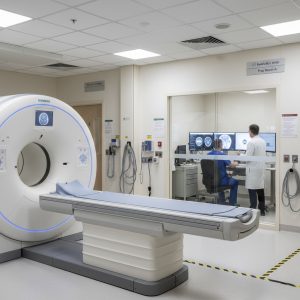


A CT scanner that goes down takes the schedule with it. Exams get pushed, emergency cases go elsewhere, and the revenue tied to that room stops until an engineer and parts arrive.
Most of that is preventable. The CT scanner maintenance tips below cover what operators, biomedical teams, and facilities staff can do to keep a scanner running and plan service spend instead of reacting to it.
Why Proactive CT Machine Maintenance Matters for Healthcare Facilities
CT is one of the highest-throughput rooms in most hospitals, so idle time is expensive. Proactive CT machine maintenance protects three things: the schedule, the asset, and the compliance record.
Financial Impact of Unplanned Downtime
An outage costs more than the repair invoice. Add the exams rescheduled or sent elsewhere, staff time coordinating the fix, expedited parts, and overtime. Planned work happens on a known date, in low-volume hours, with parts already on site.
Extending the Lifespan of High-Cost Components
The X-ray tube and detector array carry most of the replacement value in a CT system. Tube life is driven by heat cycling and use, so warm-up discipline, cooling performance, and consistent calibration show up later as tube hours.
Patient Satisfaction and Diagnostic Quality Compliance
Image quality is a compliance matter as well as a clinical one. Daily quality assurance, calibration records, and radiation output checks are the evidence surveyors ask for during Joint Commission and CMS Conditions of Participation reviews. Patients see it as appointments that hold and exams that are not repeated.
Essential CT Scanner Maintenance Tips to Maximize Uptime
These are the CT scanner maintenance tips that separate predictable rooms from reactive ones.

Address Intermittent Issues Early Before Sudden Failure
Most CT failures announce themselves first: a reconstruction that hangs once a week, an error code that clears on reboot, a fan louder than last month. Technologists often work around these because the exam still completes. Give them a fast way to report it while it is still a scheduled medical equipment repair.
Daily Tube Warm-Up Routines and Calibration Protocols
Run the manufacturer warm-up every morning and after any extended idle period, so the tube is not hit with full power while cold. Follow it with the daily air calibration the OEM specifies. If a warm-up throws an error or runs long, log it. That is often the earliest sign a tube is nearing the end of its life.
Maintain Proper CT Suite Environment: Managing HVAC, Temperature, and Humidity
Keep the suite within the temperature and humidity range in the OEM site specification. A room running warm forces thermal pauses and shortens component life.
- Monitor temperature and humidity in the scan room and equipment room, with drift alerts.
- Keep air intakes and filters clear on a recurring schedule.
- Verify chiller performance before summer peak load, not during it.
- Flag the CT suite as critical cooling in HVAC planning.
Slip Ring, Gantry, and Mechanical Component Inspection
The rotating gantry is what physically wears. Slip ring cleaning and brush inspection belong on the preventive maintenance schedule at the OEM interval, performed by a qualified engineer experienced in high-risk imaging equipment service. Contaminated slip rings produce image artifacts and data transfer errors that are easy to misdiagnose as software faults.
Uninterruptible Power Supply and Battery Backup Checks
CT systems are sensitive to power quality. Sags, surges, and brief interruptions can abort a scan or corrupt a reconstruction. A UPS only helps if it is maintained: verify battery health at the manufacturer interval, replace strings on expected service life, and confirm the scanner sits on the correct emergency power branch, as NFPA 99 expects.
Keep System Software and Security Patches Up to Date
Console software needs the same care as the hardware. Coordinate OEM updates through an authorized service partner, test PACS and RIS connectivity afterward, keep the scanner on a segmented network, and track patch status in the device record.
Establishing an Effective CT Preventive Maintenance Schedule
Good CT scan maintenance is a schedule, not a habit. Build it in three layers, each with a named owner and a record in the CMMS.
Daily and Weekly Operator Maintenance Checklist
Technologists own the first layer, and it takes minutes:
- Run tube warm-up and daily QA before the first patient.
- Record QA results and stop the room if a value is out of tolerance.
- Clean the gantry bore, table, and accessories with approved agents.
- Check table movement and laser alignment.
- Log every error code, reboot, and aborted scan.
Weekly, check cables and connectors and review the error log.
Monthly and Quarterly Biomedical Engineer Inspections
The second layer belongs to the biomedical or imaging service team: filter cleaning, cooling and chiller performance, UPS and battery verification, mechanical inspection, and phantom image quality testing. Rising tube heat units per exam or more frequent cooling pauses turn into a planned parts order instead of an outage. enBio biomedical services teams work this layer alongside in-house staff.
Annual Audits, Calibration Verification, and Radiation Safety Monitoring
The annual review covers full calibration verification against OEM specification, radiation output measurement by a qualified medical physicist, and a documentation audit confirming every scheduled PM was completed. Under CMS Conditions of Participation and Joint Commission equipment standards, the record is what proves the program exists.
Understanding CT Scanner Maintenance Cost and Budgeting Factors
CT scanner maintenance cost varies widely between facilities, and most of that variation comes from choices a hospital controls.

Key Drivers of CT Scanner Maintenance Expenses
The main drivers are system age and model, slice count, daily exam volume, whether the tube is covered by the agreement, parts availability, and how much work the in-house biomedical team performs. Ask any proposal to show those drivers line by line.
Full Service Contracts and Planned Maintenance Agreements
A full service agreement bundles preventive maintenance, repairs, parts, and usually tube coverage into a fixed annual fee. It makes the budget predictable and shifts risk to the vendor, at a higher cost. A planned maintenance agreement covers scheduled PM and inspections, with repairs billed as they occur.
Look at the terms rather than the headline rate: contracted and non-contracted hourly rates, parts markup, after-hours charges, and the termination clause. Healthcare Technology Management (HTM) solutions should be transparent on all of those before you sign.
Cost Versus ROI: Preventive Upkeep or Emergency Repairs
Compare PM cost against the failures it prevents: emergency labor, expedited parts, lost or diverted exams, and components replaced early. A tube that fails early because of poor cooling or skipped warm-ups is a capital expense caused by an operational gap.
Final Thoughts
Uptime comes from a few habits repeated reliably: warm up and calibrate every morning, report intermittent symptoms early, hold the suite within specification, inspect mechanical components on interval, and keep UPS batteries and software current.
The CT scanner maintenance tips here work best inside a managed program. enBio provides biomedical equipment management, preventive maintenance, calibration, and repair with multi-state field coverage, transparent service rates, and reporting that supports Joint Commission and CMS documentation. To review your imaging maintenance program, contact enBio support team for coverage across your CT fleet.
Frequently Asked Questions
How Does Suite Temperature Affect a CT Scanner’s Performance?
CT systems operate within a defined temperature and humidity range. When the room runs warm, the scanner pauses between series to cool, which slows throughput. Heat also stresses detectors, power components, and tube cooling, which ages the system faster.
How Do Power Fluctuations Impact CT Scanner Functioning?
Sags, surges, and brief interruptions can abort an exam, corrupt reconstruction data, or trigger errors that look like component faults, and repeated stress shortens the life of power supplies and control boards. A maintained UPS with verified battery health removes most of that risk.
How Often Should CT Calibration and Quality Assurance Be Performed?
Warm-up and QA run daily before the first patient, with results recorded. Phantom image quality testing is typically monthly or quarterly. Full calibration verification and radiation output measurement by a medical physicist are annual. Follow the OEM schedule and state radiation control requirements.
What Is the Lifespan of a Typical CT Scanner?
Most CT systems stay clinically viable for roughly 8 to 12 years, with the limit set by software support, parts availability, and whether current protocols still run well. Disciplined CT preventive maintenance is what gets full value from the asset.