





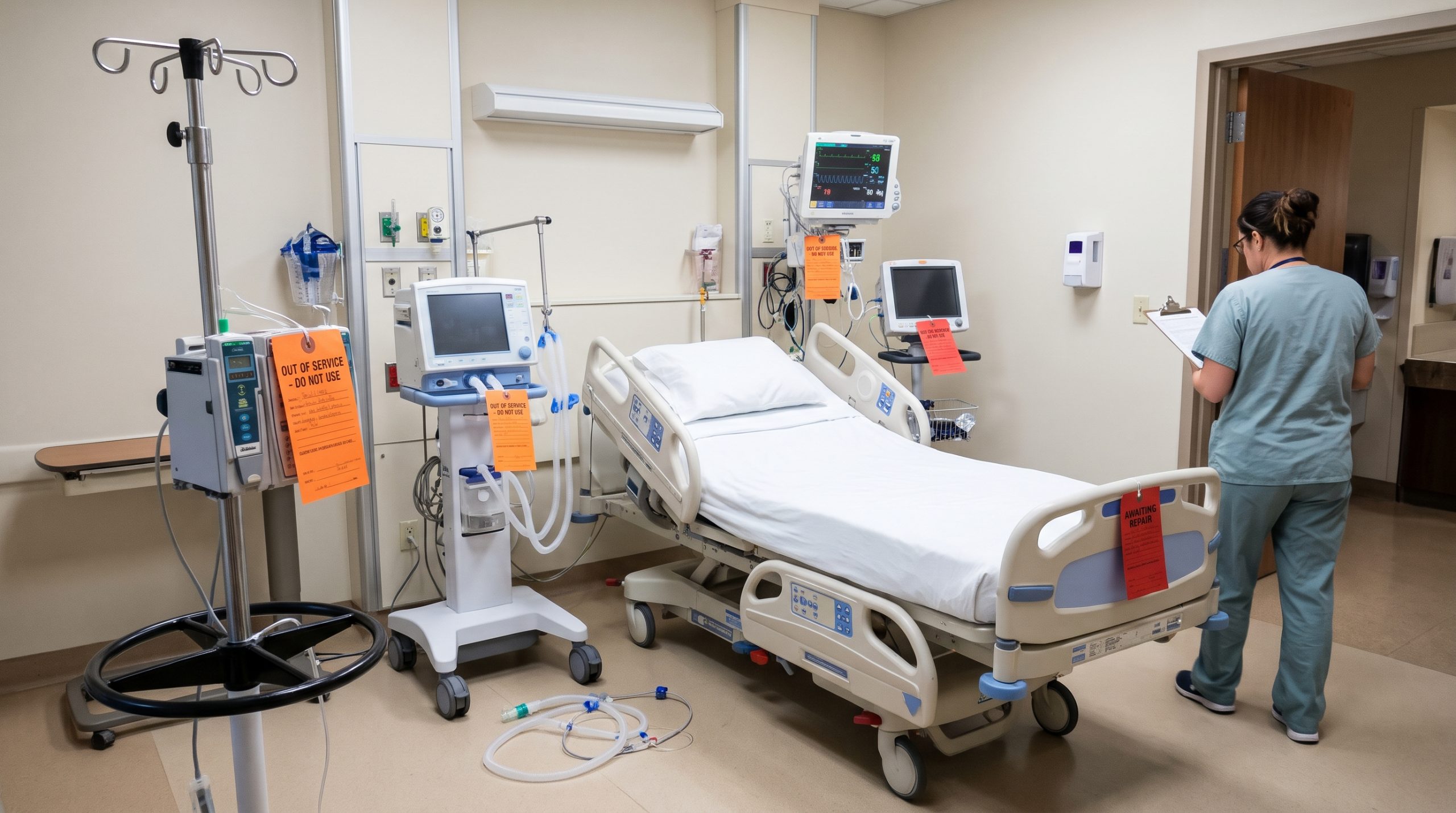
Medical equipment downtime is the time a device is unavailable because it has failed, is waiting for repair, or is out of service for maintenance. When that device is a ventilator, an infusion pump, or an operating room light, the effects reach well beyond the equipment room. Procedures move, staff spend time on workarounds, and departments lose capacity.
That is how medical equipment downtime affects patient care at the operational level: through access, scheduling, and capacity. This guide covers what downtime is, how it affects care delivery, what it costs, how to measure uptime, and how maintenance and repair programs reduce it. It focuses on equipment and operations, and it does not offer clinical guidance.
What Is Medical Equipment Downtime?
Medical equipment downtime is any period when a device cannot be used for its intended purpose. It starts when the device is taken out of service or fails, and it ends when the device is repaired, tested, and ready for use again.
Healthcare organizations also use the word “downtime” for computer systems and electronic health records. This article is about medical equipment only.
Planned vs. unplanned downtime
Planned downtime covers scheduled work such as preventive maintenance, calibration, and updates. It is usually short and can be placed around a department’s schedule. Unplanned downtime comes from failures, damage, or maintenance that was missed. It arrives without notice, which makes it harder to absorb.
Why critical equipment matters most
Critical equipment is equipment a department cannot run without, or that has no ready substitute. Many organizations include devices such as ventilators, infusion pumps and defibrillators, and sterilizers. Each organization sets its own list, and the same device can be critical in one department and a spare in another.
How Medical Equipment Downtime Affects Patient Care
Equipment downtime reaches patients through operations. Researchers who audited equipment availability in a tertiary care hospital describe downtime of diagnostic, operative, monitoring, and life-support equipment as something that can disrupt clinical services and delay procedures.
Delayed and rescheduled procedures
When a needed device is out of service, a procedure, an exam, or a test may have to wait or move. Each change affects the schedule that follows it.
Reduced capacity and longer waits
A department with fewer working devices can serve fewer people at the same time. When demand stays the same, waits grow.
Staff time spent on workarounds
Staff look for a spare unit, borrow from another unit, call for service, or reorganize the day. That is time taken from their usual work.
Limited backup for critical devices
Not every device has a spare. When there is no ready substitute, the operational impact of an outage is larger, and the pressure on repair teams is higher.
Confidence in the facility
Repeated equipment problems can affect how staff and patients view a facility’s reliability. Consistent availability supports trust.
How clinicians respond when a device is unavailable is a clinical decision for each organization. The equipment side, keeping devices available, is what the rest of this guide covers.
The Costs of Medical Equipment Downtime
The costs of medical equipment downtime are easy to underestimate because most of them do not appear on the repair invoice. Consider these cost areas:
| Cost area | What to track |
|---|---|
| Repair and parts | Service labor, parts, shipping, and outside vendor charges |
| Replacement or loaner equipment | Rental fees, loaner coordination, and time to set up and test |
| Lost or delayed procedures | Appointments or procedures moved, shortened, or canceled |
| Staff time | Overtime and time spent on workarounds and service calls |
| Compliance records | Gaps in PM or repair documentation after an event |
Why there is no single average cost
Published figures for the cost of downtime differ widely. They use different units, such as per minute, per hour, or per device, and they depend on equipment type, patient volume, and scheduling. A number from one hospital’s imaging suite does not describe a clinic’s infusion pumps. Your own numbers are the ones that matter.
How to calculate downtime cost
A simple model adds four parts:
Downtime cost = value of lost or delayed procedures + repair and parts + replacement or loaner costs + extra staff time
Use hours of downtime by device category and your own average values. Start with the devices that have no substitute.
What Causes Medical Equipment Failure and Downtime?
Medical equipment failure has many causes. Common operational ones include:
- Missed or late preventive maintenance.
- Calibration and testing that fall behind schedule.
- Wear on batteries, cables, and moving parts.
- Delays waiting for parts or a service visit.
- Software or interface problems on connected devices.
- Unclear ownership of who repairs and tracks each device.
Age alone is not the full picture. A peer-reviewed study of critical equipment in a tertiary care hospital found that downtime is influenced by maintenance practices rather than age alone. How a device is maintained matters at least as much as how old it is.
Medical Equipment Uptime: How to Measure It

Medical equipment uptime is the share of scheduled availability time that a device is ready for use.
Uptime % = (scheduled hours – downtime hours) / scheduled hours x 100
Pair uptime with mean time to repair (MTTR):
MTTR = total repair time / number of repairs
Track both by device category. Useful companion measures include repeat failures on the same device, PM completion, and the age of open work orders.
Medical equipment uptime numbers are most useful as trends. Compare the same device category month to month, and look for the devices that keep coming back.
Reducing Hospital Equipment Downtime
Reducing hospital equipment downtime comes down to two things: preventing failures where you can, and shortening repairs where you cannot. Strong hospital equipment maintenance programs treat both as one process.
Schedule preventive maintenance and finish it
Preventive maintenance finds wear and drift before a device fails. The schedule only helps when the work is completed and recorded. Regular field biomedical PM gives teams a consistent process and a record of what was done.
Use time-based and condition-based maintenance
Time-based maintenance (TBM) happens at fixed intervals, such as every six months. Condition-based maintenance (CBM) is triggered by a device’s measured condition or performance. Many programs use time-based maintenance as the base and add condition-based triggers where data supports it. Any change from a manufacturer schedule needs a documented basis.
Make repairs fast and trackable
Clear escalation, parts planning, and one place to track open repairs shorten downtime. A biomedical equipment repair process that logs each event also shows which devices fail repeatedly.
Keep calibration and testing on schedule
A device that drifts out of specification may be pulled from use. Keeping calibration current avoids surprise removals from service.
Plan for devices with no substitute
Identify which devices have no ready substitute and decide ahead of time how a loaner or backup unit would be sourced, tested, and returned.
Keep records that show the work
Complete records show where downtime comes from, and they support survey readiness. Clean PM and repair history also makes it easier to answer a surveyor’s questions about high-risk equipment.
How enBio Helps Keep Medical Equipment Available
enBio is a Healthcare Technology Management (HTM) company that supports hospitals and clinics with multi-state field coverage. enBio is a member of AAMI and CMIA.
enBio provides field biomedical PM, biomedical equipment repair, and calibration. Our biomedical equipment management services include on-site and depot support and inventory management. enBio provides service records, PM completion reports, and equipment performance data that help teams see where downtime comes from and which devices need attention.
enBio services equipment. We do not advise on patient care.
Want to reduce downtime on your critical devices? Contact us to review your maintenance and repair program.
Frequently Asked Questions
What is downtime in healthcare?
In healthcare, downtime can mean computer system outages or medical equipment being unavailable. For equipment, medical equipment downtime is any period when a device cannot be used because it has failed, is waiting for repair, or is out of service for maintenance.
What is downtime for critical equipment?
It is the same measure applied to devices a department cannot run without, or that have no ready substitute. Each organization decides which devices are critical, and the list can differ by department.
What is the average cost of downtime?
There is no single reliable average. Published figures use different units, such as per minute, per hour, or per device, and they depend on equipment type, volume, and scheduling. The most useful number is your own, calculated by device category.
How do you calculate the costs of medical equipment downtime?
Add the value of lost or delayed procedures, repair and parts costs, replacement or loaner costs, and extra staff time. Use hours of downtime by device category and your own average values, and start with your most critical devices.
What is the uptime of equipment?
Medical equipment uptime is the share of scheduled availability time that a device is ready for use. Calculate it as scheduled hours minus downtime hours, divided by scheduled hours, then multiply by 100.
What causes medical equipment failure?
Common operational causes include missed or late preventive maintenance, calibration that falls behind, wear on batteries and cables, delays waiting for parts or service, software or interface problems, and unclear ownership of repairs.
What is the difference between TBM and CBM?
Time-based maintenance (TBM) is done at fixed intervals. Condition-based maintenance (CBM) is triggered by a device’s measured condition or performance. Many programs use time-based maintenance as the base and add condition-based triggers where data supports it.
What are the best ways of reducing hospital equipment downtime?
Complete preventive maintenance on schedule, keep calibration and testing current, make repairs fast and trackable, plan for devices with no substitute, and keep records that show where downtime comes from.
What do you call someone who repairs medical equipment?
A biomedical equipment technician, or BMET. Some organizations also use the title clinical engineering technician. BMETs perform preventive maintenance, calibration, and repair on clinical devices.