


Why Hospital Bed Maintenance Matters for Patient Safety and Cost Control
A hospital bed is far more than a frame and a mattress. Electric motors, side rails, brakes, casters, and control panels all work together to support safe patient handling and pressure injury prevention. When hospital bed maintenance is neglected, the risk of entrapment incidents, unexpected bed failures, and fall-related injuries increases significantly.
There is also a financial case for staying ahead of hospital bed maintenance. Reactive repairs after a breakdown almost always cost more than routine preventive maintenance, and a bed that is pulled from service unexpectedly can disrupt patient flow across an entire unit. Facilities that invest in structured hospital bed maintenance typically see fewer emergency service calls and longer intervals between major repairs.
Understanding Hospital Bed Lifespan
Most hospital beds are built to last between seven and fifteen years, though actual hospital bed lifespan depends heavily on usage intensity, environment, and how consistently preventive maintenance is performed. A bed in a high-acuity ICU handling frequent repositioning will wear differently than a bed on a lower-volume medical-surgical floor.
Facilities that document usage hours, track service history, and follow manufacturer-recommended preventive maintenance intervals tend to get the most years out of every unit. Skipping inspections or deferring minor repairs is one of the fastest ways to shorten hospital bed lifespan and increase the likelihood of a costly failure at the worst possible time.
Building a Preventive Maintenance Schedule for Hospital Beds
A documented preventive maintenance schedule is the foundation of any effective hospital bed maintenance program. Rather than waiting for something to break, preventive maintenance identifies wear patterns early, when a simple adjustment or part replacement is enough to resolve the issue.
A well-structured schedule typically spreads tasks across several frequencies, so nothing gets overlooked between annual inspections:
- Daily: Visual checks by nursing staff for visible damage, loose rails, or unusual noise
- Weekly: Function tests on controls, brakes, and casters by facilities or biomed staff
- Monthly: Lubrication of moving parts and inspection of electrical connections
- Quarterly: Load testing and structural inspection of the frame and side rails
- Annually: Full preventive maintenance service, calibration checks, and documentation review
The chart below illustrates how these tasks are commonly distributed across a preventive maintenance calendar.
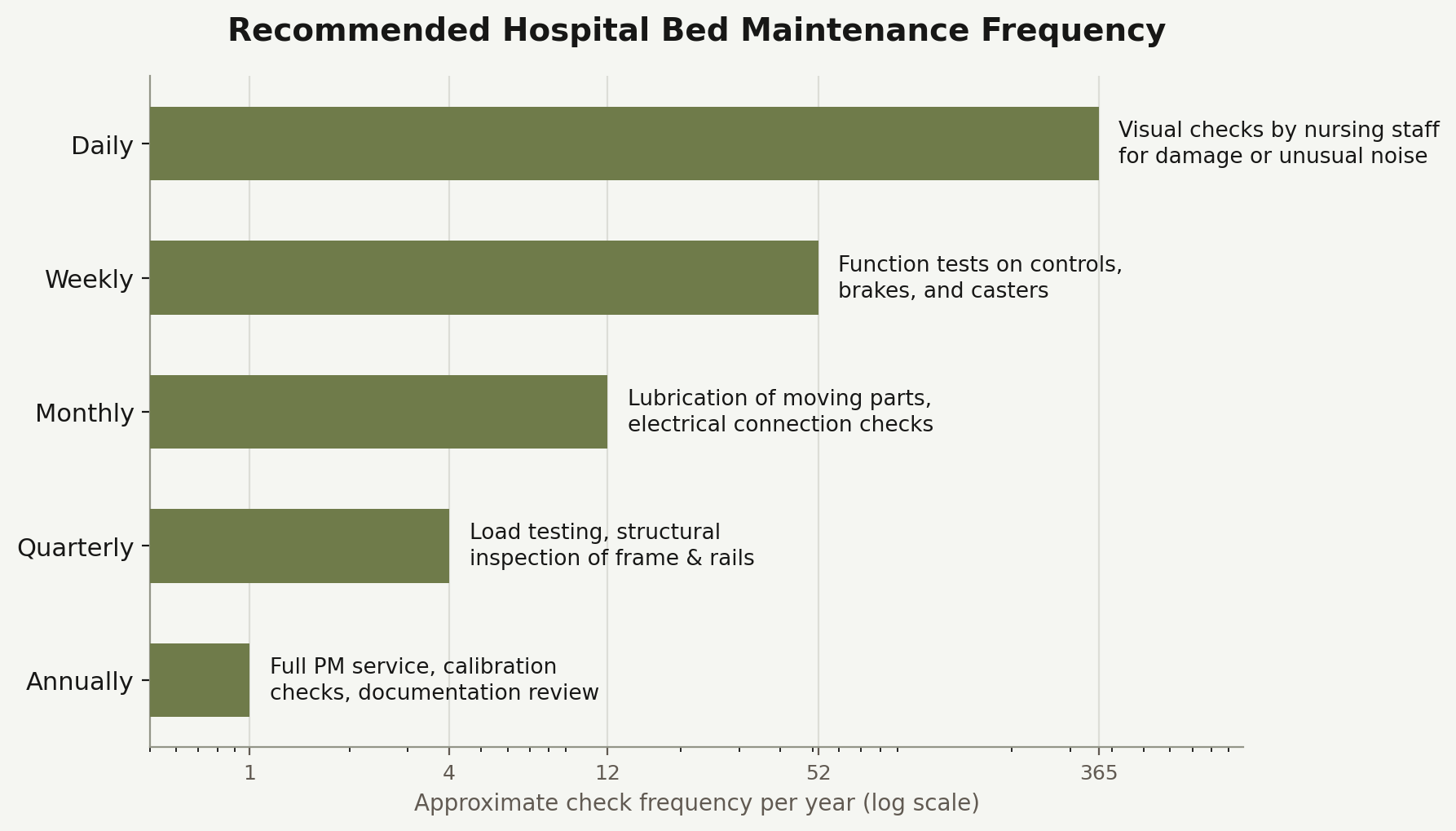
Following this kind of preventive maintenance cadence keeps small issues from becoming large ones and supports a stronger hospital bed maintenance record during Joint Commission and CMS surveys.
Daily and Weekly Hospital Bed Inspection Checklist
A simple hospital bed inspection routine, performed consistently, catches most problems long before they affect patient care. Staff and biomed teams should look for:
- Frayed or exposed wiring near the control panel or motor housing
- Side rails that do not lock securely or show visible cracking
- Casters that stick, squeak, or fail to lock
- Mattress platform sections that do not raise or lower smoothly
- Unusual noise from motors during height or position changes
- Loose or missing hardware on rails, brakes, or the frame
Logging the results of every hospital bed inspection, even when nothing is found, creates the documentation trail that supports both preventive maintenance planning and compliance reporting.
Common Hospital Bed Problems That Signal It’s Time for Repair
Even with a strong preventive maintenance routine, hospital bed repair needs will come up. Recognizing the early warning signs helps facilities schedule hospital bed repair before a unit fails completely:
- Motor hesitation or delayed response when adjusting height or position
- Error codes on digital control panels
- Batteries that no longer hold a charge during power outages
- Brakes that fail to hold the bed in place
- Visible rust, corrosion, or frame damage
Addressing these issues through prompt hospital bed repair protects both patient safety and the facility’s investment. Deferred hospital bed repair is one of the most common reasons beds fail well before the end of their expected hospital bed lifespan.
When to Repair vs. Replace
Not every issue calls for replacement. Many problems, including worn casters, minor electrical faults, and mattress platform misalignment, are resolved through routine hospital bed repair. Replacement typically becomes the more practical option when a unit requires frequent repairs, when replacement parts are no longer available from the manufacturer, or when the frame itself shows structural fatigue.
A biomedical equipment management partner can help facilities weigh these factors objectively, using service history and inspection data rather than guesswork, so decisions are based on documented condition rather than assumption.
Partnering with a Biomedical Equipment Management Provider
Many facilities manage hospital bed maintenance internally, but a growing number rely on an outside biomedical equipment management partner to standardize preventive maintenance across every unit and location. A dedicated biomedical equipment management program brings trained technicians, documented service records, and consistent scheduling that in-house teams are often stretched too thin to maintain alone.
enBio supports hospitals and health systems with field-based hospital bed repair services, structured preventive maintenance programs, and full biomedical equipment management support designed to extend the useful life of hospital beds while keeping facilities audit-ready.
Explore enBio’s biomedical equipment management program to see how a structured approach can reduce downtime across your fleet.
Documentation and Compliance for Hospital Bed Maintenance
Beyond keeping equipment functional, thorough documentation is what turns a hospital bed maintenance program into a survey-ready one. The Joint Commission and CMS both expect facilities to demonstrate that medical equipment, including hospital beds, receives regular inspection and service according to a defined schedule.
At minimum, a hospital bed maintenance record should capture the date of service, the technician or team responsible, the specific checks performed, any parts replaced, and the outcome of the inspection. Storing this history in a centralized system, rather than paper logs scattered across units, makes it far easier to produce evidence during a survey and to spot recurring issues on a specific bed before they become a larger hospital bed repair job.
Facilities that centralize this data also gain a clearer picture of true hospital bed lifespan across their fleet, since patterns in service frequency and repair type often reveal which units are approaching the end of their useful service life well before a catastrophic failure occurs.
Frequently Asked Questions
How often should hospital beds be serviced?
Most manufacturers recommend a full preventive maintenance service at least once per year, with more frequent functional checks performed monthly or quarterly depending on usage.
What shortens hospital bed lifespan?
Skipped inspections, delayed repairs, high patient turnover without adequate cleaning, and lack of a documented preventive maintenance schedule are the most common factors that shorten hospital bed lifespan.
Who is responsible for hospital bed maintenance?
Responsibility is typically shared between nursing staff, who perform daily visual checks, and biomedical or facilities teams, who handle scheduled preventive maintenance, hospital bed repair, and compliance documentation.
Keep Your Fleet Running with a Trusted Hospital Bed Maintenance Partner
A consistent hospital bed maintenance program protects patients, supports compliance, and helps facilities get the most value from every unit in their fleet. If your team needs support building or managing a preventive maintenance schedule, enBio’s biomedical equipment management specialists are ready to help.
Contact us to discuss hospital bed repair services and preventive maintenance coverage for your facility.